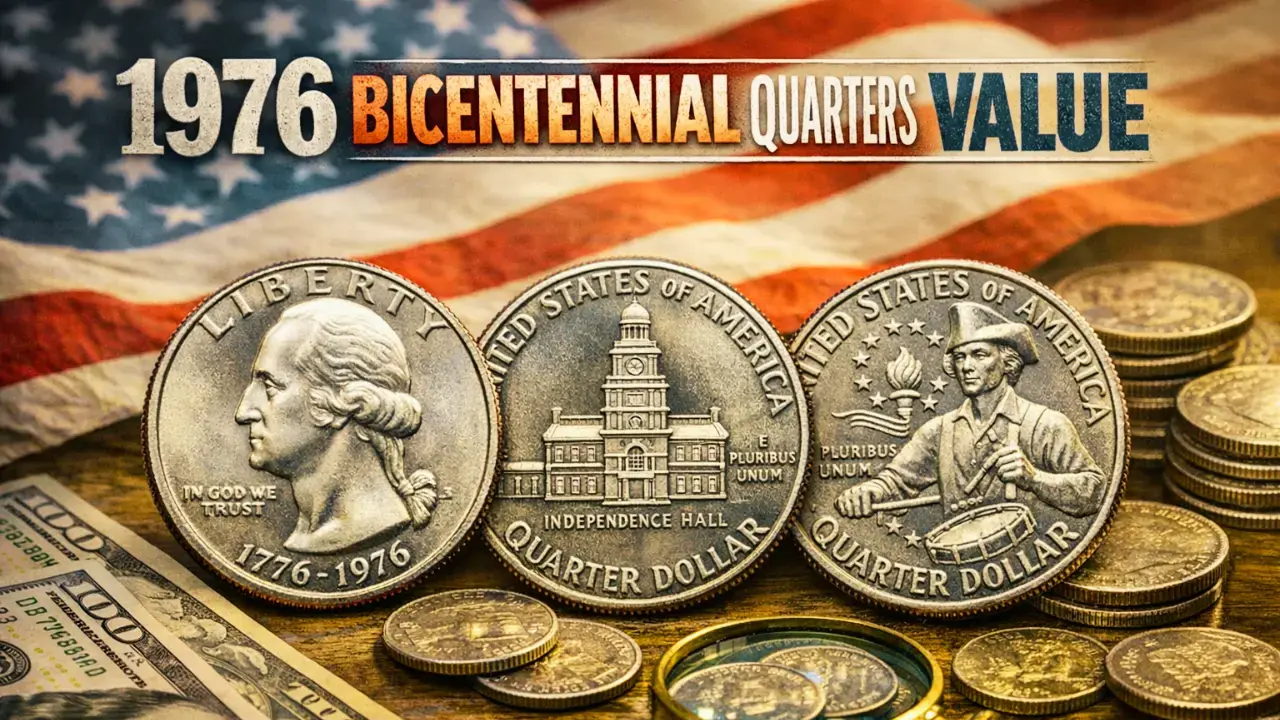
The 1976 Bicentennial Quarters Value reflects current market interest in the special dual-date 1776–1976 U.S. commemorative quarters minted for the American Bicentennial. These modern circulating commemorative coins were produced in large numbers, yet some high-grade, silver-composition, and proof versions attract significant collector attention. This coin appeals to both new collectors and investors seeking affordable modern commemorative coins, while top-condition examples and special mint strikes continue to show strong price activity in the current numismatic market.
Coin Specifications
The 1976 Bicentennial Quarters’ value depends heavily on the coin’s basic specifications. Each coin measures 24.3 millimeters in diameter, with the clad version weighing 5.67 grams and the silver version weighing 5.75 grams. The obverse bears the dual date “1776–1976,” while the reverse features a Colonial drummer holding a torch surrounded by thirteen stars. These coins were produced at three U.S. Mints and were struck in both circulation and collector formats, offering collectors a variety of coins in a single commemorative issue.
Metal Composition
The standard circulation version of the 1976 Bicentennial quarter is made of a copper-nickel clad composition, consisting of 75 percent copper and 25 percent nickel, bonded to a pure copper core. Special collector versions were struck in a 40 percent silver composition, containing approximately 0.0739 troy ounces of silver. These silver quarters were sold in mint sets and proof sets, which increased their intrinsic metal value. This variation in metal composition plays a significant role in determining the overall value of the 1976 Bicentennial quarter.
Rarity and Demand
Although over 1.6 billion Bicentennial quarters were produced across all mints, most are in circulated condition and sell for face value only. Collector demand is primarily for uncirculated examples that have a strong luster, well-defined details, and minimal marks. Silver versions and proof coins are also less in demand than standard circulation pieces because their distribution is limited. The value of 1976 Bicentennial quarters increases significantly for coins graded at the highest level, where supply is much lower than for lower-grade examples.

Minting Details
Bicentennial quarters were produced at three U.S. Mint facilities: Philadelphia, Denver, and San Francisco. Philadelphia coins have no mint mark, while Denver issues bear a “D” mint mark. San Francisco produced both clad proof coins and special 40 percent silver uncirculated and proof versions, all marked “S.” Total production exceeded 809 million coins from Philadelphia, approximately 860 million coins from Denver, and several million special collector strikes from San Francisco, making the mint mark and strike type a very important factor in determining the value of 1976 Bicentennial quarters.
Condition and Grading
Condition plays a key role in the value of 1976 Bicentennial quarters. Circulated coins are generally graded between Good and Extremely Fine, with obvious wear and minimal detail. Uncirculated coins range from Mint State 60 to Mint State 70, with higher grades having a brighter luster and almost no surface marks. Proof coins are examined for clarity, mirror finish, and strike sharpness. A standard circulated coin typically fetches face value, while a Mint State 67 example can reach several hundred dollars depending on its appearance.

Market Value
The value of current 1976 Bicentennial quarters varies greatly depending on composition and grade. Circulated clad quarters typically fetch $0.25. Uncirculated clad coins typically fetch $1 to $15 in Mint State 60 to 65. High-grade examples of MS67 or above can sell for between $300 and $1,200. Silver uncirculated quarters typically fetch $5 to $15, depending on condition. Silver proof coins often sell for $10 to $25, while top-grade proof examples can exceed $200, and rare top-population coins reach $4,500.
Investment Potential
1976 Bicentennial Quarters hold decent investment appeal, especially for high-grade or silver specimens. Circulated coins have limited profit potential due to their large supply, but certified mint state or proof coins, which are visually appealing, continue to attract collectors. Silver versions have intrinsic metal value, giving them a price floor based on their silver content. Investors often focus on coins graded MS67 or higher, where limited availability supports strong premiums and long-term value growth potential in modern U.S. commemorative coin collections.

Conclusion
The value of 1976 Bicentennial quarters ranges from common face-value circulation coins to premium collector pieces worth thousands of dollars in top condition. The coin’s copper-nickel or 40 percent silver composition, dual-dated design, and numerous mint variations create a wide value spectrum. Most examples remain affordable for beginners, while high-grade and silver proofs command good prices. Its commemorative value, affordable entry cost, and the potential for premium-grade examples keep this quarter relevant among modern coin collectors and investors.